

About Helicons
Pioneering a new modality to unlock traditionally undruggable targets
Our Helicon™ platform empowers us to engineer precisely tuned, stabilized helical peptide therapeutics for cell penetration and highly specific binding to flat intracellular protein target surfaces.
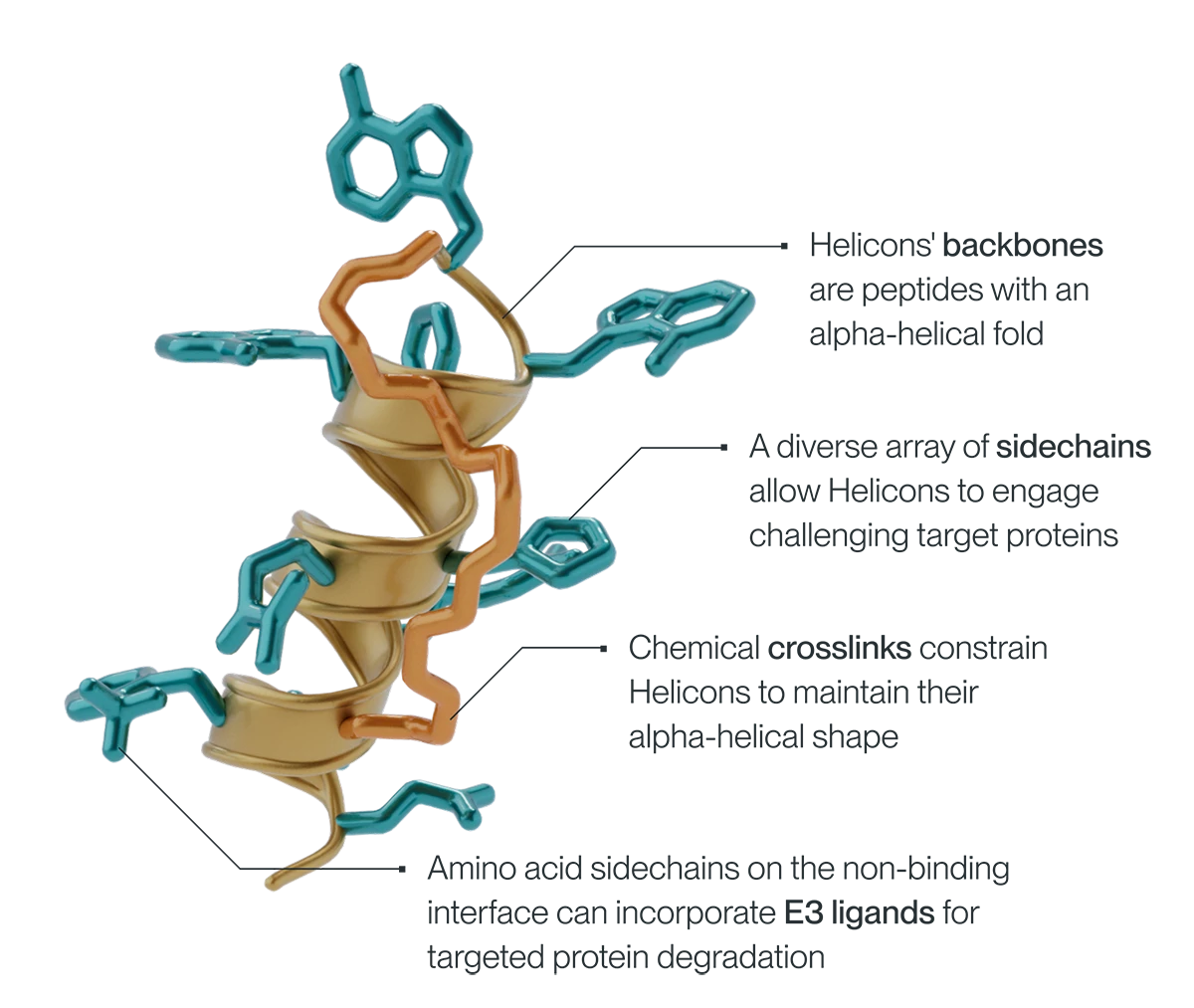
Helicons’ key advantage, their alpha-helical shape, takes its inspiration from nature. This coiled structure provides Helicons with unique drug-like properties, including the crucial ability to safely and efficiently cross cell membranes and reach intracellular targets.
Helicon therapeutics combine the strengths of small molecule drugs with those of monoclonal antibodies. Like small molecule drugs, they allow cell permeability and broad tissue distribution. Like antibodies, Helicons have high specificity, are able to block macromolecule:macromolecule interactions and bind to relatively flat surfaces. Helicons can be used for a very wide range of targets across many diseases.
In addition, Helicons’ vast tunability — enabled by a very large diversity of non-canonical amino acids — represents an important advance from traditional peptides, and allows us to engineer our therapies with optimal physical properties and manufacturability.
An estimated 80% of biologically validated disease targets are considered undruggable, largely because the majority reside inside cells, making them inaccessible to antibodies, and present flat interaction surfaces that small molecules cannot effectively bind.
To our knowledge, Helicons are the only modality to date with the potential to consistently solve this problem as they combine the precision of antibodies and biologics with the intracellular access and tunability of small molecules in a single modality.
Astronomical diversity
Our AI- and simulation-enabled Helicon platform provides an unprecedented level of flexibility for modifying the crucial chemical and biological properties of peptides — bringing full small molecule diversity to the side chains of polypeptides. We routinely employ more than a thousand different amino acids, which brings astronomical diversity to our Helicon peptides, more than twenty orders of magnitude greater than for natural peptides.
vs.
Natural peptide of 20 amino acids possible structures
teaspoon of water
Helicons possible structures
the water of 10 billion Earths
Helicon advantages
Efficiently cross cell membranes to bind intracellular targets.
Display a diverse array of sidechains along an extended interface, allowing strong and highly selective binding to a chosen disease target.
Tunable clearance characteristics to achieve short or long plasma and tissue residence times.
Evade recognition by both proteases and MHC proteins, resulting in high stability and low immunogenicity.
Applying Helicons to solve therapeutic challenges
We’ve demonstrated the potential of Helicon peptides to serve a range of therapeutic purposes, including:
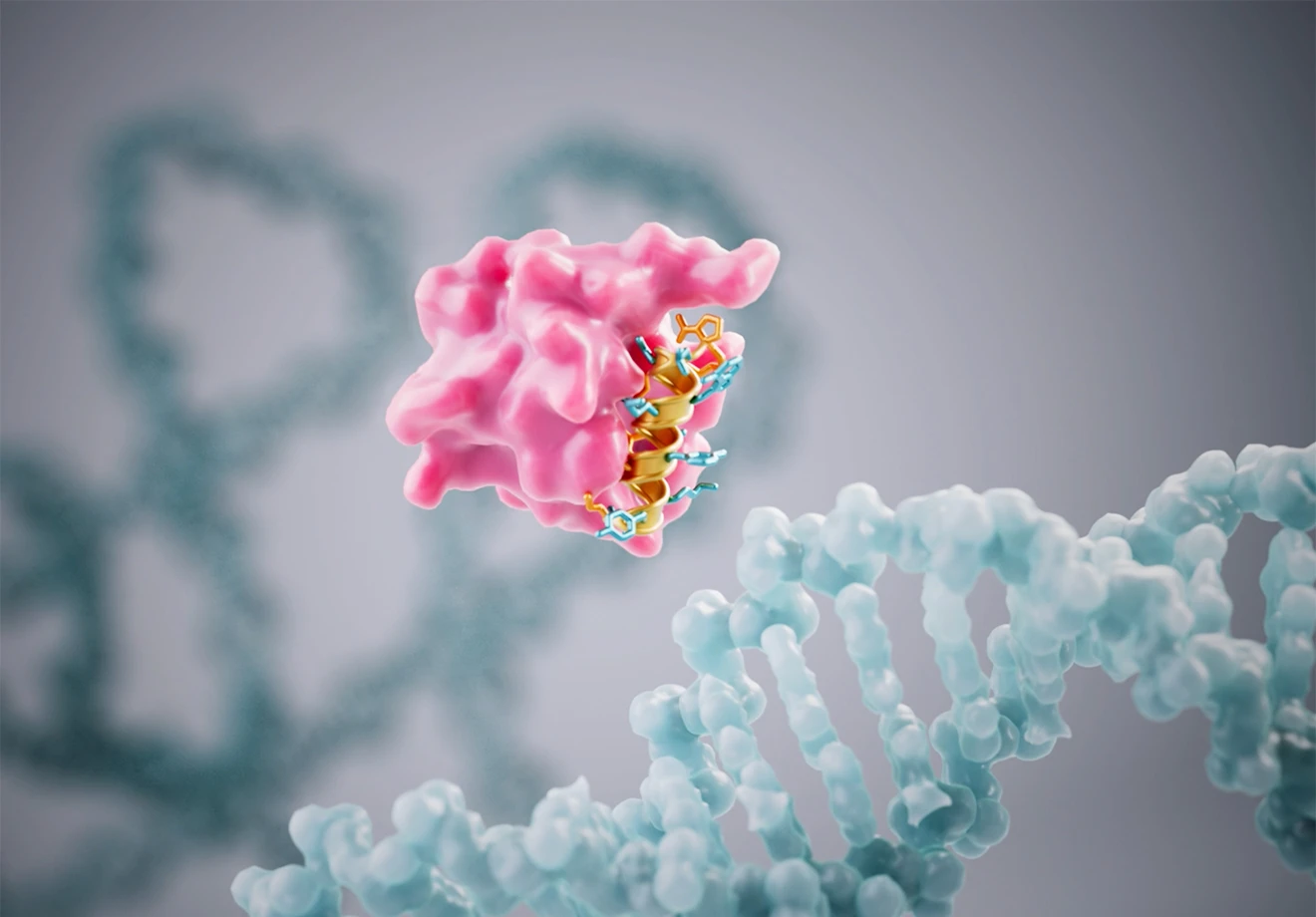
Functionally inhibiting protein-protein and protein-DNA interactions
Our Helicons are like intracellular antibodies. Thanks to the ability of Helicons to cross the cell membrane and bind challenging protein surfaces, we have the opportunity to drug and inhibit a wide range of protein-protein and protein-DNA interactions inside the cell that are out of reach for other classes of medicines. Our lead investigational program, zolucatetide (previously known as FOG-001), is an example of how Helicons can be used to successfully inhibit pathogenic protein-protein interactions in patients.
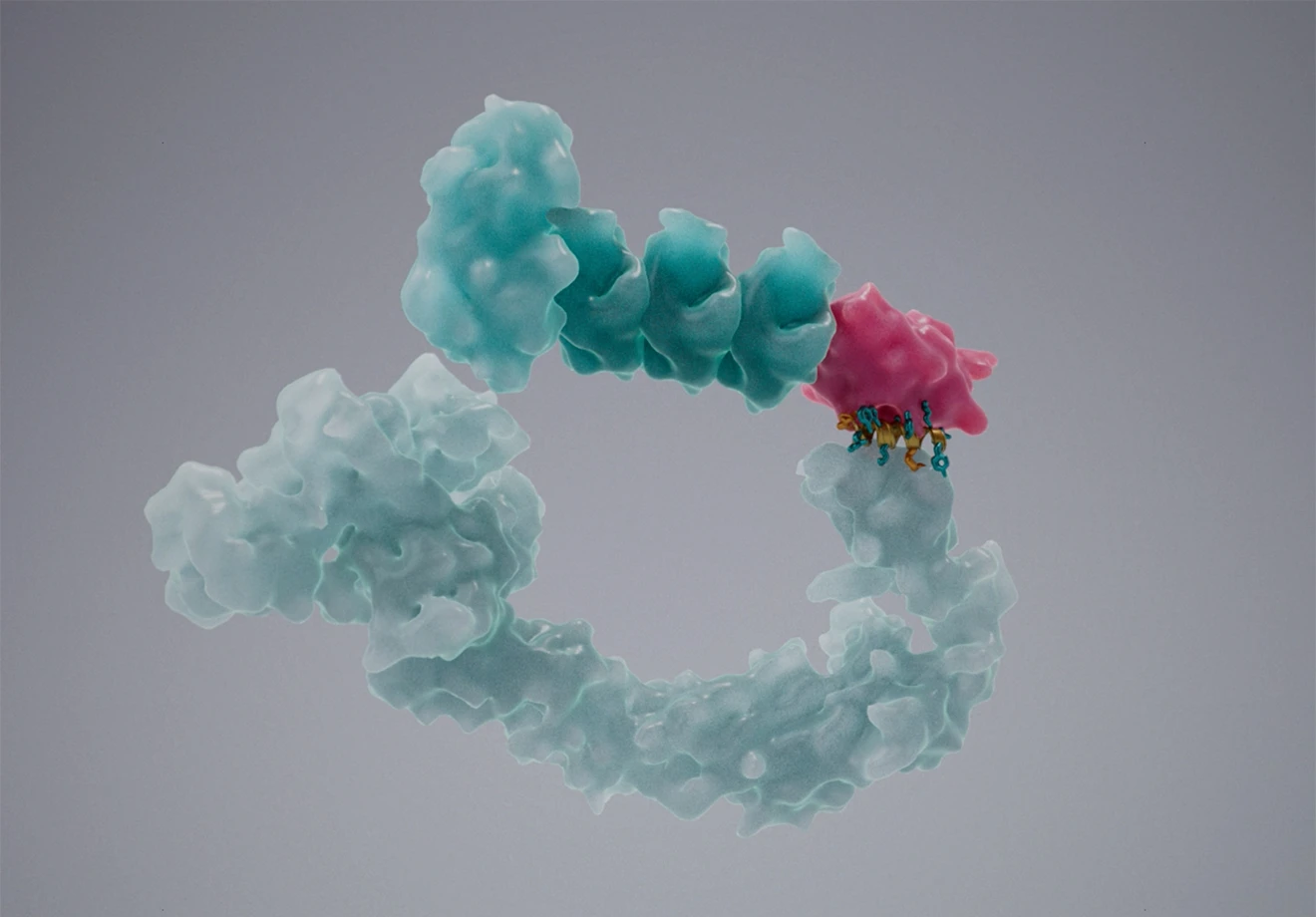
Protein degradation
Helicons’ broad target-binding abilities, intracellular penetration, and range of linker attachment points enable them to carry out targeted protein degradation to eliminate disease-driving proteins, including those that small molecule glues and degraders cannot access. A wide range of ligands for E3 ligases can be incorporated as amino acid side chains on a Helicon.