

When a platform advances a novel modality through a virtuous cycle of computation and experiment, it creates a substantial and unique competitive advantage. In our previous post, we focused on the Helicon™ platform and the potential it offers for a wide range of therapeutic applications. In this post, we examine how deep internal expertise, platform-wide digitization, closed-loop experimentation and computational advances transform the Helicon modality into a scalable, defensible engine for drug discovery.
In today’s life sciences investing environment, the term “platform” often carries skepticism. Investors have seen many compelling scientific stories that fail to translate into clinical progress, or incremental refinements of established approaches that add limited real value. But there is value in platforms that not only generate tangible and unique insights but are also focused on a genuine modality that can provide solutions to important problems considered previously intractable.
At Parabilis, that modality is the Helicon. Helicons are not just another twist on something old; their ability to enter cells, modulate protein–protein interactions, and serve as a scaffold for functionalization, combined with their unique construction and properties, gives them formidable power to unlock traditionally undruggable targets. The Helicon platform is built not just to generate molecules, but to systematically unlock targets long considered undruggable.
Modality to competitive advantage
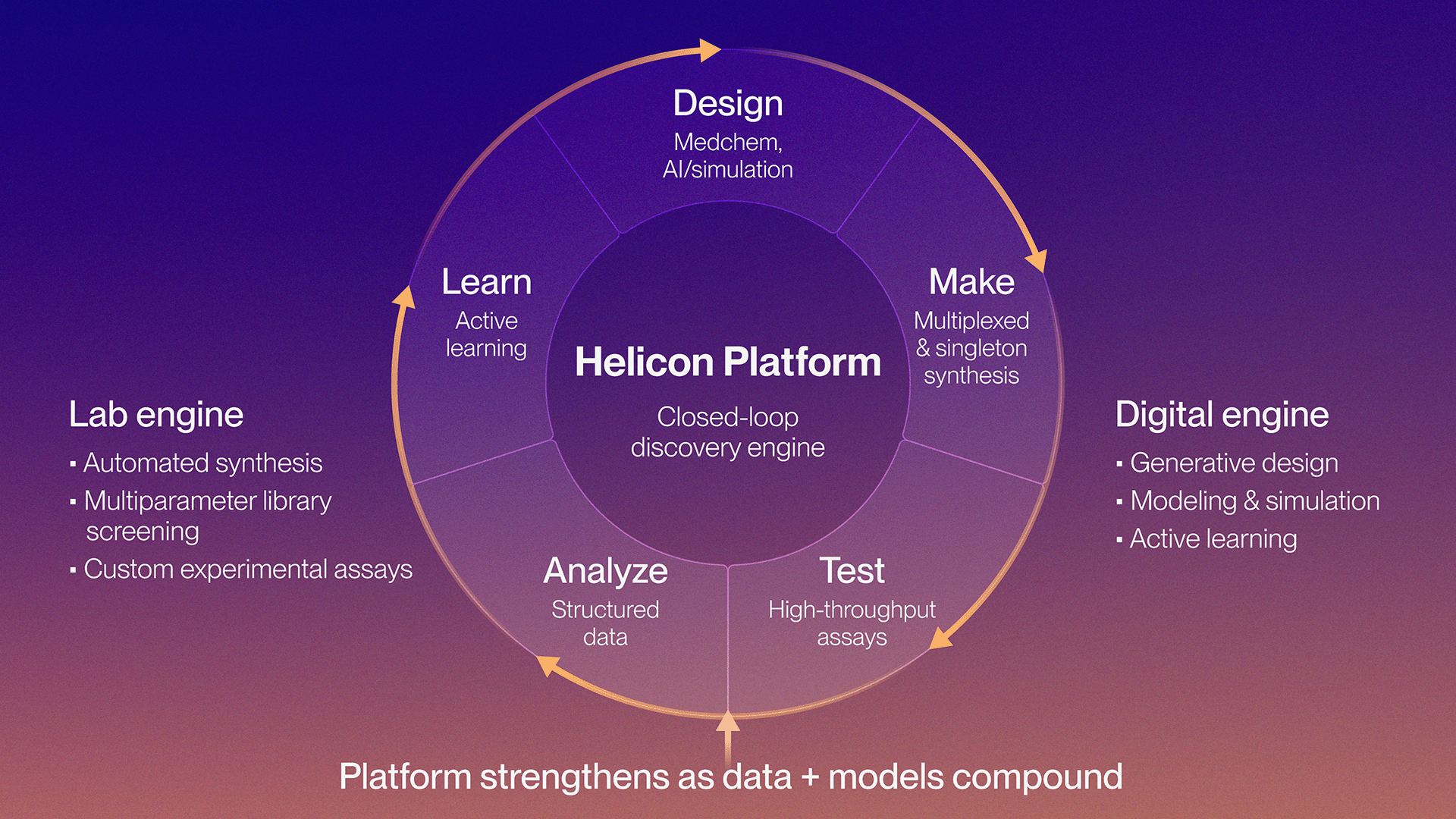
The Helicon itself is only a part of the story. The tightly integrated Helicon platform, combining new laboratory capabilities with equally novel computational capabilities, elevates Helicons from a promising idea into a durable competitive advantage. In this integrated system, lab experimentation, digital modeling and simulation work together in a continuous loop cycling from bench to bit and back again. Every experimental phase generates rich, structured data; every computational phase uses that data to propose better Helicons and smarter experiments. Over time, this compounding knowledge creates a self-reinforcing flywheel: insights accumulate, design quality improves, and the platform’s advantage widens, growing our moat wider and deeper.
On the lab side, the Parabilis team has spent over ten years developing proprietary capabilities, from synthesis techniques to assays, which have become a major source of high-content data. As an example, in hit-to-lead, the team has developed a set of multiplexed synthesis and testing workflows that produce many Helicons in a single synthetic reaction and test them directly as a crude mixture. These assays can assess binding, stability, permeability, and other properties at a significant scale, meaning that a single design–make–test–analyze (DMTA) cycle can return a high-dimensional snapshot of hundreds or even thousands of Helicons, rather than a handful of data points on a few structures. More data per cycle makes every cycle more informative, especially when those readouts are captured and standardized for use in artificial intelligence (AI).
On the digital side, internal advances in complex Helicon design systems, novel non-natural amino acid-containing peptide representations, AI modeling, and novel simulation techniques let us use that data to power design in each cycle and progress rapidly from hit to lead. Over time, we have produced a large one-of-a-kind data set on purified Helicon peptide structures, feeding AI models based on multiple physio-chemical properties. This growing dataset has also enabled the development of an active learning process and, in turn, robust AI models for target-specific assays. The end result is the ability to conduct very rapid hit-to-lead and lead-op campaigns, especially when design decisions in each DMTA cycle are not only informed by AI models but are paired with generative AI approaches.
The power that makes this a flywheel is modern data and software foundation. From synthesis records to assay results, data flows through a unified, machine-readable pipeline instead of being trapped in notebooks, slides, or one-off spreadsheets. This creates a proprietary, Helicon-specific data product, and a growing suite of models and simulation techniques that are increasingly difficult to replicate. As the platform has matured, we’ve seen DMTA cycles compress by more than 3x, hit quality improve earlier in programs and design quality improve in later-stage programs, allowing our teams to tackle disease biology that would have been out of reach just a few years ago.
Crucially, this advantage is not just a collection of point solutions – it compounds. Each cycle strengthens multiple layers at once: the experimental engine generates a more structured, Helicon-specific signal; digitization turns that signal into a reusable data asset; and models and simulations convert it into better designs and more informative experiments. The result is a system that gets faster and smarter with use, steadily widening the gap relative to teams that must rebuild workflows and intuition program by program. In other words, the Helicon platform is not merely a way to run discovery; it is a scaling mechanism for learning, and that scaling is what makes the competitive edge durable.
Together, these capabilities are accelerating our current pipeline and the next generation of Helicon therapeutics, with promising preliminary results observed to date. Importantly, FOG-001 (zolucatetide), the first and only inhibitor of the β-catenin:TCF interaction, provides early clinical proof of the Helicon modality. In parallel, we are advancing multiple preclinical programs targeting other cancer drivers. These advances represent tangible progress from the platform and provide concrete evidence of a formidable competitive advantage – one that uniquely positions Parabilis to deliver on the promise of the Helicon.
Authored by Brandon Allgood, Data Science & Engineering team member